Tag: tree management

  • Digging near trees and why you should know what you are doing then

    A brief article to inform people of how to go about digging near trees and why it matters.

    Digging occurs for many reasons but the most important (for the tree) usually occurs when a trench is being dug for foundations or utility, such as for cables or pipes (there are many ways tree roots can be damaged but I am concentrating on digging damage).

    Tree roots, usually, do not go below a meter in depth in the ground as there is not enough oxygen below to sustain them (through respiration). This is why it is usually feasible to dig under tree roots (Figure 8.16) instead of through them to install cables and pipes. For trees with tap roots, one can dig under the roots but to the side of the stem rather than directly under it.

    Construction work near trees should be properly evaluated as most root damage to trees often occurs during this time but the effects will only be seen several years later.


    Here is an example of poor planning and devastating results:

    A new construction was planned to go around this tree (image) as it was a central focal point. The tree was not considered sufficiently. The result was that many roots were destroyed during excavation and a main branch was to be removed. I was called in by the owners who could clearly see that the tree had become a hazard as the above ground parts stretched for over 15 meters each direction and the below ground parts were all cut off at 1.5 meters in each direction. The only outcome was removal of the tree as the stability and health of the tree was severely compromised.

    Construction work near trees should be properly evaluated as most root damage to trees often occurs during this time but the effects will only be seen several years later. The UK minimum root protection area is 12 times the diameter of a tree measured at 1.5 meters from ground level (a 12 meter radius for a 1 meter diameter tree). Before digging within this area root presence or absence should be verified. Foundations within this area are most often of the pile variety rather than the typical trench foundation.

    Please think next time you want to dig near trees, especially if you want to build as close as you can to that special tree, because that may just shorten its life time significantly and defeat your purpose.

    If you want more info, clarifications or advice, you are welcome to contact me. [email protected] or 7598103616
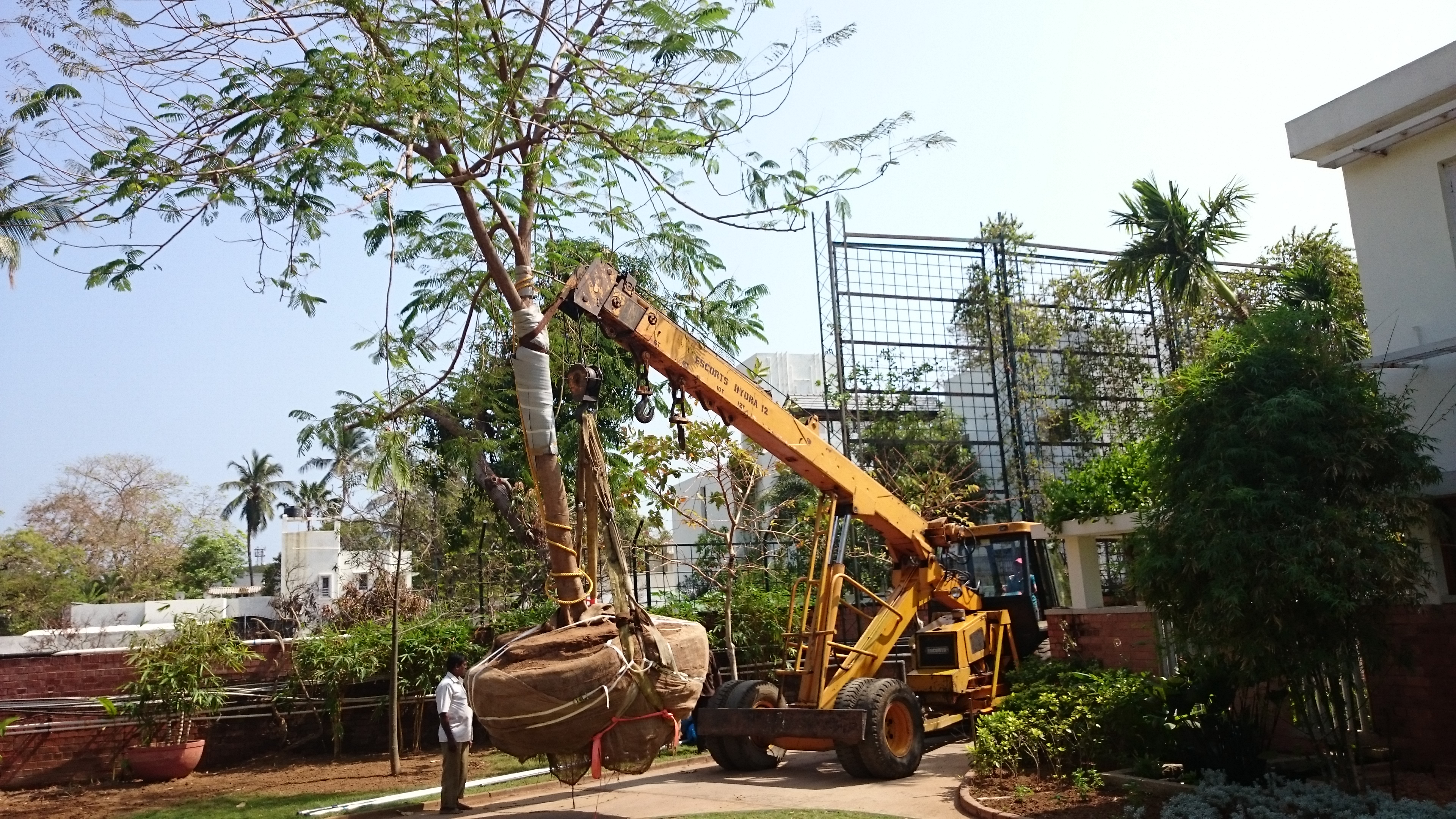
  • Transplanting a Tree in India, Delonix Regia var. flavida

    Tree transplant India
    Tree transplant India

    The transplant of this tree occurred to place it in a more appropriate place (more space).

    It was completed in collaboration with Tree Care India for a member of TVS Corporation LTD.

    It is a special tree as it was brought as a seedling from the Galapagos Islands. It produces yellow flowers unlike the common Delonix regia.

    Photos and videos of the project can be found by clicking on this link: Photos

    Some details of the tree, its initial condition and transplant information: Transplanting observations

    Current aftercare method statement: Planting Aftercare Method Statement

    If you have a tree in India that you think might benefit from being moved to a better location, please get in contact with myself or Tree Care, India (link above).

    We would also be happy to discuss details with regards to anything tree related.

    I hope this will inspire people to move some trees instead of just chopping them down.

  • Trees need surveying for multiple reasons. Here are a few.

    When tree surveys will/might be beneficial:
    1: When buying a property that includes trees which might affect the initial or long-term price due to maintenance or removal of said tree(s).
    2: Tree safety surveys (anywhere where many pedestrians or motorists visit often): in public areas such as schools, on private land or on commercial areas such as car parks. This serves to prove that the landowner is fulfilling their duty of care (not being negligent) and as such reducing the risk of damage to persons and property.
    3: Development surveys compliant with BS:5837, 2012 Trees in relation to design, Demolition and Construction. To be included in planning applications where trees are present. This will also include trees that may be damaged by vehicular traffic on the site and will also include trees in neighbouring properties whose roots and/or branches may be affected.
    4: A Condition report, to give a idea of the state of the trees on a site. This would possibly also include a management plan: what tree work is required or if other inspections (possibly aerial) are required down the line. This would include timescales for the work required or re-inspections.
    5: Management plan: More often for older trees, veterans and ancient. If retrenchment is required to keep an old tree with a lapsed pollard from failing structurally, it may be beneficial to reduce the tree in stages and perhaps help it in other ways such as removing some competition (other trees), ameliorating the soil (perhaps with an airspade) etc… to enable reducing the tree without killing it a few years down the line.

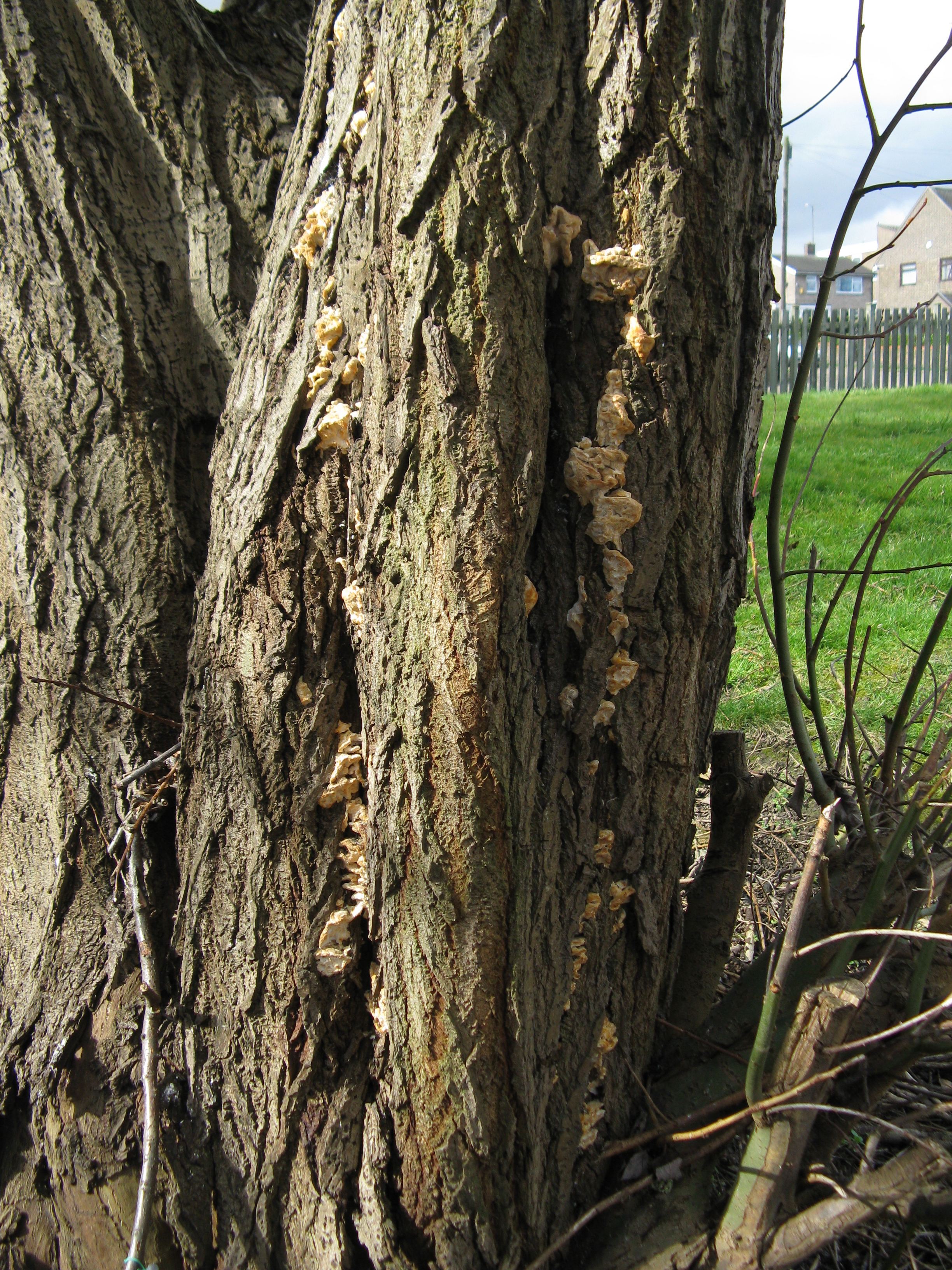
    Laetiporus sulphureus on willow
    Fungus fruiting bodies on willow